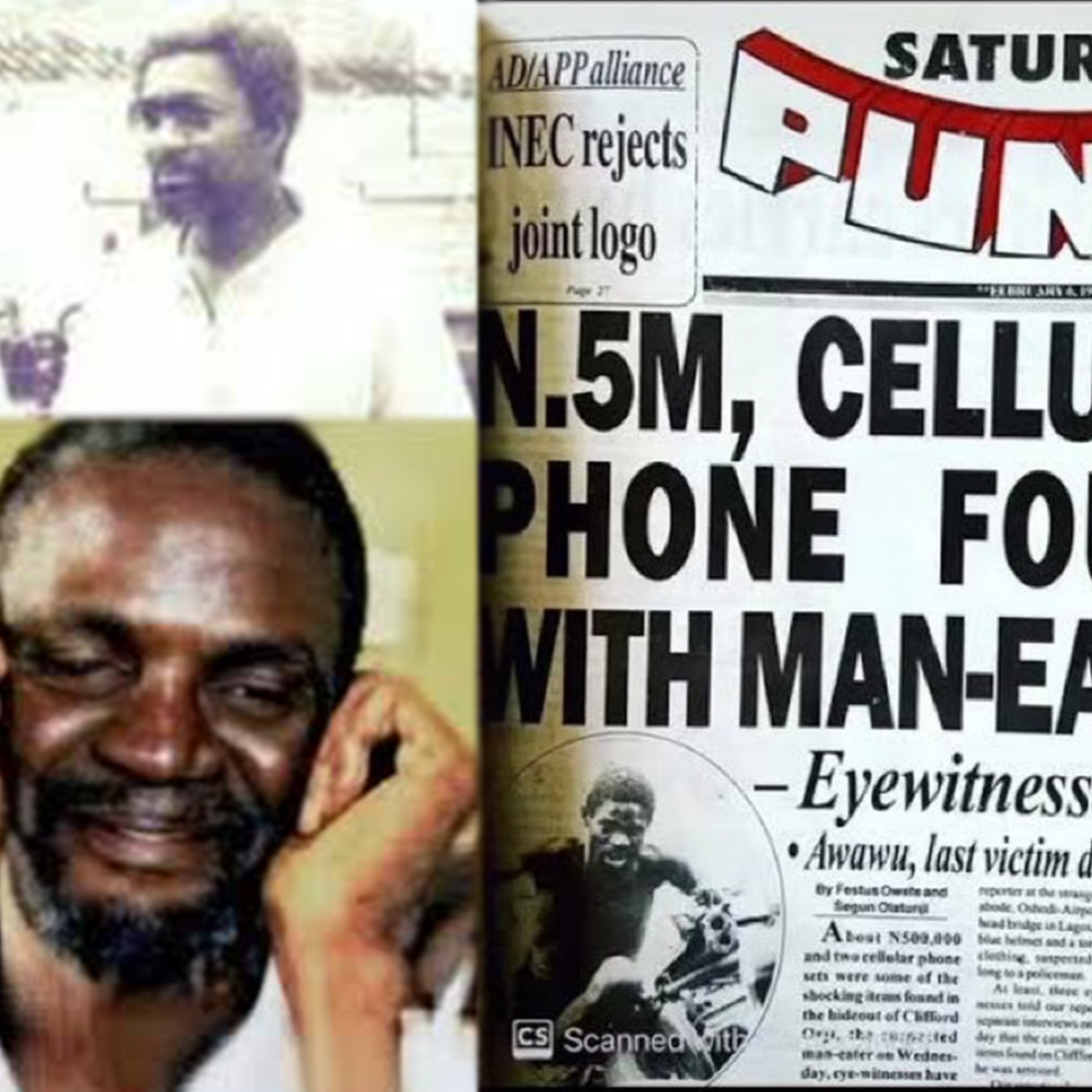
The Cannibal of Lagos (Clifford Orji)
The program
In the early 2000s, a quiet part of Lagos became the center of one of Nigeria’s most disturbing discoveries.
What started as suspicion quickly turned into horror. A man living in isolation, human remains found nearby, and a story that blurred the line between crime and survival.
This episode breaks down the case, and how a single discovery turned into one of the most chilling stories ever told in Nigeria.
If you hail from a small village or a small city and you've lived there your entire life, have you ever dreamed of moving to a big city before? Or are you totally and perfectly happy where you are? I believe a lot of people always feel the need or feel the urge to move to a much bigger city when they are in their early adulthood, especially if they're from a small town or a small village, because they believe they can get more opportunities in the big city. Today's case, we're talking about opportunities and a particular man who took the same opportunity as the one I just mentioned, and it did not turn out for him as greatly as it turns out for some people.
A lot of people always find themselves battling against all Lords when they move to a bigger city because first, everything there is different. The lifestyle, the pace, the opportunities sometimes are overwhelming. Too big for you and you want to dream big, but you don't want to dream too big and you don't also want to dream too small. Today's case is the story of Clifford OR, a man who was later known as the first known cannibal in Lagos State. Before we dig into it, first disclaimer. This episode contains discussion of murder, mental illness and disturbing events.
Listener discretion is advised. Nothing here is glorified. It's told purely for awareness, history, and understanding of how dark the human mind can get when society completely ignores it. Clifford Orgy born in 1965 or 1966. His actual birth date is not really confirmed because even Wikipedia was unsure of his actual date of birth. So he was born sometime between 1965 and 1966. He's born during that time and he's born into a very religious household and they were not wealthy or financially stable.
They were doing OK. He had the siblings and the neighbors said he grew up a very bright and polite child. He got basic education. He went to primary school and half of his secondary education before he dropped out. So he's able to communicate clearly with people. He can read basic English, and he's not that fluent, you know, very educated. But he's also not an illiterate where you cannot have a cognitive conversation with him. When he turns a teenager, he starts to decline socially and mentally.
He starts to disassociate from people and keeps to himself. The neighbors start to notice this decline. And they're all wondering what's happening because this is a child that is bright and polite and very social. And suddenly he's keeping to himself. He's no longer talking to people. And then when he's in his late teens, he starts having this manic outbreak where he yells at everyone. He's erratic. He's causing his teen, you know, like, almost like a psychotic behavior. This is a time that in Nigeria, I think basically anywhere in the world, mental illness wasn't really a thing.
So in Nigeria, if you had a psychotic work or something like that, they would think it is spiritual. Someone spiritually after you, someone is attacking you. When he starts to show all the signs, his parents, they obviously believed that it was a spiritual thing. So they take him to church, they take him to see prophets and to be prayed for. We all know prayer cannot cure mental illness, but back then, they believed this was a spiritual thing and prayer would do the trick. So nothing changed. Because we're here in his early 20s, he UPS and leaves one day.
His parents don't know where he's gone. His siblings don't know. Poof, gone. Up until he resurfaces on the news, his family wouldn't even have an idea or any inkling that he had moved to Lagos because they knew he vanished. They didn't know where he went or if he was even alive anymore up until he showed up on the news again years, many years later. And it turns out that he's a cannibal. And they're like, oh, so that's where you've been. So in his early 20s, he moved to Lagos with big dreams to do, you know, better for himself, to find better fortunes.
And there was something about Lagos that chews you up and spits you out. You have to be fearless. You have to be ready to not give up because chances are, the first time you show up there or when you arrive there, nothing is going to go the way you imagined. When I moved to Lagos, I had this big dream. Oh, I've got a job opportunity waiting for me and I've I've got this family member that's going to accommodate me and I'll get my job, I'll get started. It was going to be a good salary, not the best, but for a young girl my age, it was going to be enough.
And I'm going to save enough. I'm going to eventually get my own place and I'll save enough. I'll start a small business from my house and I'll make money and hopefully my life will just keep going up and up and better and better.
Third night in Lagos, the family member that was supposed to accommodate me, yeah, she left me out to dry. Job opportunity never existed. I was so convinced I was, I was made to believe I had a job opportunity waiting for me, but there was none. So now I'm here high and dry. Lagos can do that to you, I believe It's not just Lagos. I think it's something that happens when you move to any big city. Say you move from your small town in some part of America to LA or to New York, You're literally going to be wiping sweats off your forehead.
So the same thing applies in Lagos. So many people move there and they believe it's going to be easy and easy. I've got it all figured and I've got it all planned and I will do nothing outside the plan. But nothing goes according to plan. He wasn't an exception. Nothing went according to his plan. Before you know it, he was on the road selling razor blades. I guess I get back then selling razor blade would make enough money because how much do razor blades cost these days? But yeah, that was what he did back then.
He would sell razor blades and that makes you not enough to survive. So before you know it, he decides. He tells people, I am now a native doctor and Native doctors are doctors that can cure you spiritually because, you know, we have actual doctors that cure you physically when you're sick, even mentally. But we have also native doctors that say they can cure your spiritual problems. If you have a spirit or a demon or an enemy that's torturing you spiritually or you have this sickness that doctors clinically cannot diagnose or cure, we can do it.
So he certainly tells people on the same St. that he sells razor blade that he is now native doctor. He would advertise his services to anyone who comes close enough to him to listen. Over time, he couldn't afford a proper because he builds himself a shack under a bridge in Oshudi and he lives there. How are under bridges in your country or your your state or your city, your town? If you're anywhere in Africa, I'm sure under bridges in wherever you live, wherever you come from, it's exact same as in Nigeria.
But if you are in like say America, in Australia, in Europe, I'm sure it's pretty different. Very uneventful place, unnoticeable place. No one even knows that under bridge is a place in Nigeria. Under bridge is. It's under bridge is an economy of its own. It has its own ecosystem. It has its own presidents and rulers, figuratively. A lot goes on there. It's not like this quiet dead place with grass and crickets and lizards. For one, bus drivers, they load their buses there. They use those points as bus stops where you could board a bus to your destination or you could board your your bus from another place having this under bridge as your destination.
So many places in the country they use under bridges as a bus stop, bridges, overhead bridges, and all those fly over bridges. Under those bridges there are vendors, people that are selling street food, people that are selling fruits, and they're also technicians, people that want to quickly repair your phones, your laptop or your gears. And there are also other vendors that are selling things like appliances like lamb quick fan, even battery headphone headsets and basic things like that that they believe you can easily just haggle with them and buy and go.
And there are also people who say we are selling you authentic Balenciaga T-shirt. You see this T-shirt right here, Balenciaga and the Balenciaga is spelled wrong. And it will give you a Nike that the logo is all completely different. And they would swear to heaven and bike this is original and I'm selling it for this price. And people who don't know, they would be like Nike, Nike, give it to me. Also, in between all the people that are trying to honestly make a good living, there are also people who are there waiting for a little sign of chaos, just a little sign of chaos.
And boom, they jump in and they rob people, they pickpocket, they just snatch the snatch. They just hang around, watch the crowd, watch everyone's movement and wait for someone to bump into another person. And the person will shove them back a whole scene and they jump in. Everyone's busy, No one's watching their things, snatching A snatch. This was something that took me a bit of learning when I moved to Lagos. I stayed there briefly for almost 2 years is almost two years briefly. Sorry if I'm speaking a little too fast today that I normally do in all the other episodes.
It's because I am literally high on caffeine right now. I feel sporadic accommodate me. Thank you. So back to the story, this chaos, the life, the everything going on in the under the bridge not made for the weak. I came from a small town where under the bridges are like picnic gardens, where under the bridges are decorated. They have this plush field of grass, beautiful with some trimmings and some seatings where people can sit and have snacks. And just around the bridge also there are vendors who are selling street food.
They're selling snacks, fruits and some cheap shoes like slippers, which they, again, they would claim our original quality, sell your bags, wigs and some thrift clothes. And you go there just to peruse what they're selling with your friend and buy snacks, sit at the seatings, eat and just unwind. And during Christmas, the governor of the states would decorate those bridge areas with Christmas festivity things, you know, all those lights and colors and it would be so beautiful. Their families would go there.
Even on Christmas Eve, they'll be there. It's totally peaceful. No one's ever fighting. You go there and you go home with all your things intact. No one's threatening you, no one's harassing you. That was what I was used to, what under bridges felt like. So imagine when I moved to Lagos and I realized that under the bridge, it's murky. People are trying to get too close to you. Everyone's sweaty because of the temperature. It's always hot. It's always hot in Lagos. I don't know why it's always hot.
Even during rainy season, it's always hot. Under the bridge is a very scary place that you don't want to be trapped in, you don't want to be stranded at, you don't want to be there after dark. And I say this out of experience. I was caught under the bridge in Aja just before dark, and I believe it's luck and God that I'm alive today. We move around every day and we don't know that this minute could be your very last. This is where Clifford finds himself, under the bridge where you can be robbed with people literally 100 or 200 meters away from you.
While he's advertising himself as a native doctor, it turns out that no one really needed a native doctor. At least no one wanted his services. So he would act mad. Some days you'd see him and he's acting mad. He's insane. He's yelling at people, he's fighting people just like mad people that have no cognitive skills do. He's creating huge drama in public. And then you meet him another day and he's so calm and collected and behaves properly and is very aware of his actions during that time. Also, since selling off razor blade isn't making him money and being a native doctor isn't also making him money, he took up begging as a profession.
Yeah, that was a profession. So Clifford, back in the 90s, he had this brilliant idea. I should be begging because I'm already playing the part of a madman. So if I'm mad and I'm begging, no, But it's heartless like that not to help me. So brilliant. He starts to beg. And people would give him food, some would give him money. And then another day he would show up at the same Oshodi bus stop and he would act completely, saying he would buy himself food, he would buy himself clean clothes. He would look so prim and proper.
And another day he's in ragged clothes and looking all tattered, and he's doing terrible things that no one had an idea about up until one day his whole world comes crashing. And that's when people realized that this madman slash Vega slash native doctor was actually a cannibal, a man eater. And not just is he luring, killing, cooking and consuming humans, he consumes the part that he cannot sell because he's selling this humans. And whatever part that people who buy him parts for rituals deem unneeded are the parts he eats.
So on February 13, 1999, a guy was returning home from church, I think he said, And he passes by the bus stop in Oshodi. And he hears this shrill like, you know this, this shrill of someone in pain. He follows the sound because there are shacks around of all those homeless rich people, because this is a bus stop. You don't expect to hear this deep, gutted, painful shrill of someone who is in pain and just broken. So he follows the sound and he goes to this shack that he sees at the bridge, you know, under the bridge, and he walks towards it.
It's on the proper house, so there are holes and stuff all over it. So he peeps into it. He sees a man hunched over fire that's grilling something, and there is smell of not quite meat but barbecue in the air. And he looks closer and he sees that the things on this grill that he's barbecuing are parts like that. And he's, well, you can tell how someone would feel if you saw that. You're never expecting that. He walks away quietly because he doesn't want to tip him off. And he calls the police. The police arrives and they catch him right-handed with the barbecued meat.
And at this time, crowds showing up and everyone's wondering what's happening and the news already spreading that the person in there is grilling human parts and obviously eats them. At this point, when he discovers he's been discovered, he makes a run for but he's quickly caught. I mean, they're used. They're they're police officers. They're they're onlookers, bystanders. They catch him. And once they caught him, he's so calm. He's not panicked, he's not worried. He's smiling. He's just smiling like he's pleased with himself.
And he's taken to the station and his place is being thoroughly searched. And that's when they find rusty frying pans, bucket bowl containing bones, grill on another metal bowl, firewood parts, the roasted ones he just finished barbecuing. And they also found rice, yam, Gary pepper and oil. And they also saw a freshly cooked pot of soup with meats in it. And they saw cutlasses, knives and cellular phone. They saw money, a check for 80,000 era. And just when they thought they've seen it all, they found a woman that was hidden somewhere in the room, like a very dark hidden spot that you'd never even think a grown human or a grown person can fit into it.
They found this, this very malnourished, emaciated woman that was tied up and was to be next. So basically they would capture people and they would tie you up for days until it's your turn to be killed. And they could have more than one person at a time. And you'd see one of you be taken out and never to be returned. And the next time they'd come back and they'll pick someone else and you're just waiting for when it's your turn. So she's there, she's tied up, she was to be soon, which must be why she was crying.
And thankfully she was discovered. But it didn't really change much for her because she's rescued, she's taken to the hospital and she falls into a coma and she dies days after. So that's really sad. It's really sad. But before that, during the time that she was tied up waiting to be killed, Clifford would also use her as his ex slave, probably using her to fulfill all his perverse fantasies and imaginations. Anyways, she was discovered as well. And also the cellular phone that was discovered. This is in 1999, mobile phone just introduced to the Nigerian market.
Only the top officials, the rich, rich and famous people had phones at that time. It would take you years to work and save enough for it. And he had a Nitel phone which was this, you know, blocky phone with buttons. And when he was later interrogated and asked how he got the phone, he he claimed that some of his buyers, some of them were higher up officials. So they would pay for the parts with sometimes gift offerings like the phone or pay him enough money that he's able to afford a phone. I actually believe it because if those were the type of people that had phones at the time, him buying a phone, who's he going to speak to with the phone when everyone around him, all the people he knows, which he didn't know much people, they don't have a phone.
He would only get a phone so he can keep in touch with people who have a phone at the time were rich people. So he said, yeah, that's why I had a phone. And the Czech as well, yes, that's where I got it from. He was taken to prison and then he was taken to see a couple of psychiatrists and psychologists and they all had different diagnosis. Some would say, oh, he's schizophrenic and some would say he's psychotic and some would say, no, he's totally fine. He's just a very highly manipulative person because whenever people were to 1 close to his shack, especially when he's grilling meat again and again and again, you know, today he's grilling, tomorrow he's grilling and people are just, you know, all the other homeless people, they're getting tired.
Where is he getting all this meat from? It doesn't smell like beef. Where is he getting all this meat from? So sometimes people would walk close to his shack to maybe ask him questions or see what's happening and he would act totally mad. He would take a rod and he would chase them, you know, like a metal. He would chase them if he gets too close, he could even smack you and he would act so erratic. So people would naturally just stay away from him and his shack and whatever goes on there. So the doctors were, some of them would say that's manipulation because sometimes he would appear completely normal, but then anytime someone comes close to his shack, he's cuckoo bananas.
Due to all of this, the government didn't really see him quite fit to stand trial. They sent him to prison, and he would be transported to the hospital sometimes for welfare checks and to see how he's doing and all that, and he would be transported back to prison. He was held at Kirigree Correctional Facility, which is the only supermax facility in Nigeria. And I hear it's brutal there. It's brutal. It's supermax security. Like, you can never, ever escape there. The only way to subdue criminals like that.
I'm sure there is a bit of, you know, extreme power going on there. So I've heard things about it. And I love what you guys are doing there because I don't ever want to be there. I love what the government's doing in Kirigree. Good job. Yeah. He was held there for 13 years. He didn't stand trial. He wasn't released. So after 12 years of being in prison again, he's sane enough to know either you guys prosecute me legally or let me go. So he sues the state. On April 26th of 2012, he challenged his detention.
He was like, hello, either you prosecute me or you let me go. Oh my God, guys, you won't believe. I literally just finished the entire episode and then I realized that this thing stops recording literally halfway through and now I have to repeat the other half again. OK, let's do it all over again. So he says to them, either you prosecute me or you let me go because I'm just sitting duck here. What's happening? So during his interrogation, he was asked, you know the initial interrogation he was asked, why do you eat meat?
He said because that's the only meat I know. I've been eating meat since 7 years before I moved to. Lagos and that's the only meat I know. And he was asked if you were released today, would you still eat? He said yes, I would. There's no difference between meat and beef or goat meat, so I would. And he was asked how do you get the victims? He said, well, he would lure them sometimes because they were mostly hawkers, you know, people that sell on the road, those vendors. He would tell them I want to buy whatever you're selling and they would come to him.
He would tell them, oh come, my money is in my shack. They would come and he would attack them and keep them and tie them up. After his lawsuit was ignored, he dies four months after that on August of 2012. And at this time, a lady who's an Elijah. Elijah is a title like for important people, just like Madame. So she comes out and says, oh, I was actually almost one of his victims. And she was asked what happened. And she said, oh, I was out looking for my daughter. The daughter's name is Ara. She has sons.
And she said the daughter was really interested in talking drum, and she was a drum. And she said she wants to focus on music. She doesn't want to go to school. And she and her husband were like, no, you can go to school. You should go to school. We can afford to send it to any school to whatever level you want. All your brothers are graduates. They all are university graduates. You should be educated. And she said, no, She wants to be a drummer, which actually has paid up for her. She's a decorated African drummer.
But at the time, she would go from studio to studio to, you know, record herself drumming and all that. And one time, the mother says she doesn't return. And her maternal instinct was at trouble. Go look for her daughter. So she tells one of her sons you should drive me. Let's go look for your sister. And she says as they're approaching the bus stop, you know the ocean, the bus stop 2 flashlights come out from nowhere and start flashing at them signaling for them to slow down. And she says they do.
And as they're slowing down to men come out of nowhere and they approached a car and have a tall instinct again. It's like something's wrong. They don't look like police officers and they also don't look like vigilante. So get yourself and your son out of here. You don't want to lose another child while looking for one child. So she tells the son in book it and the Sun does, and just at that very split second that they book it, one of them already had gotten to her side of the car and was about to open her car door.
They book it. And she says later on when the news breaks out, she says, yes, they look like the same people that are being accused of this. They were the same people that attacked us at night. And he said, yeah, she was almost a victim to Clifford. So now Clifford is dead in prison. And one would think, oh, that's the end of of the whole cannibalism and the killing of people for ritual under the bridge. But it wasn't in the same year that he dies, November of 2012, a man who is a member of the vigilante group, you know, the youth vigilante group, is just walking past the Oshodi under bridge.
And he sees a man like sneak into a hole in the ground and then sneaks back up with a bag, a sack bag. That's an old rice bag that used to have rice in it before, but it doesn't look like it has rice in it now. And he would go back in and come back with another bag and that. And he's like, what's going on? This man looks crazy suspicious. So he calls the rest of the vigilante group. They come, they catch him in the act and they ask him what's in the bag. He opens it and it's rotten human flesh. So they ask him, what's this?
Explain yourself first. You know, of course they get a better him up so he can speak fast. And he starts confessing. He says, yes, He has been dealing on the selling of flesh for over 15 years. That's been his work for 15 years. Before that, he used to be an Okada rider. This is the hierarchy of transportation in Nigeria, Okada and then Tuktu and then bus and then taxi and then owned cars. So Okada is at the lowest and it's sometimes one of the most convenient, especially during traffic in a place like Lagos with heavy traffic, you're in a standstill, you're not moving, you're running late.
But people on Okada can easily weave through the traffic and beat it. So technically, they get a lot of patronage because Lagos is very congested. You always get a passenger. But the problem is it's the lowest on the hierarchy. So they're making little money. And he says he wasn't making enough to get by. So one of his friends introduces him to this business and he accepts it, and he's been doing it for 15 years. I just wanted to, like, stab my eyes out and never read again because when I was reading, I wish I didn't, I had to convert it so you can understand how ridiculous it is.
And the total amount that he charges for an entire bean is less than what I spent on a plate of meal and an eat tree on my last visit to Nigeria. He said that would be 7500 naira, which would be $45.25 in 2012 and $5.25 in today's money price would be 1500 naira and in 2012 $9.45. And today $1.05 P would be 1000 naira, in 2012, $6.03. Today 7 cents Hansen X would be 3500 naira. 2012 it would be $22.05 and today's money $2.45. So total 13,500 naira which in 2012 would be $85.05 and today $9.09. That's how much life was worth to him.
13,500 And honestly if he was focused on riding the bike he would make that much even even if not more. In a month he would have easily made that much but he chose not to. But instead he would do this. So he was caught and he was asked for your clientele and he said, oh, people who want to get rich, people who want to battle evil spirits or any other type of sacrifices and priests like prophets, people who want to do rituals to acquire powers to perform miracles. So unfortunately, the bridge still operates in such nature where people are still there and they prey on women only women because most times they're not strong enough or have the audacity to approach men.
So they attack women whom they deem weak enough and a lady who is a journalist wanted to write on the under bridge, you know, the operations going on there. So she goes there and she acts as a client who wants to purchase the services. So that's the only way you can get the full scope if you go there as a client and interact with them. So she goes and she says in her words, I will quote her. She says all manner of young men surrounded me asking how they could help me. They asked if I wanted spiritual bath to attract a rich suitor or a millionaire boyfriend, if I wanted the spiritual bath for success in business or promotion in my workplace, or if there was somebody I wanted them to deal with.
Out of curiosity, I started asking them the price for each service and they started reeling out all manner of prices that their leaders stops them and authoritatively demanded what I wanted. And now I explained that my boyfriend abandoned me for my best friend and they asked again what treatment I wanted, whether I wanted him back or for them to deal with them. They now started telling me the price for each required service. They said I should pay 7500 to have a spiritual bath that would attract him back to me.
From a distance I sighted 2 naked women being bathed with leaves by some funny looking men in a shallow stream under the bridge. I told them that I had only 4000 naira which they collected and asked me to return with the balance to see the Baba that would administer the spiritual bath. I had this feeling that if not for the money I gave them, they would have done something sinister to me. That was how I left the place and never went back. Truthfully, they would have because it's just like being a realtor or a shopping assistant.
You take this client around or someone you think is a client and you show them all your products or services. You explain everything, the benefits and all. They check the bathroom 10 times and they check the floor to see if it squeaks. And after all that they tell you, okay, you'll hear from me maybe and the walk away, you're going to feel like it just exerted your energy, your time wasted. And especially for people who are on the streets that they're here for money and they're in numbers. They would definitely jump you and you fit the profile.
The type of people they make victims, a young able bodied woman, they would have done something to her. But again, these are people that barely see good cash. So 4000 hours to them is not cheap money. And to get it for practically doing nothing, Yeah, that was a win. So she she practically bought her life with 4000 and good for her, she was smart enough to know that the second recording is quite shorter than the first. Honestly because I am afraid that something might go wrong again and I have to do it a third time.
But I hope everything has been said. And I would like to say one last thing very important. This is not to scare people who are planning or will plan to visit Nigeria Liga specifically because the government are doing things to curb this. Please plan nature very well, but ultimately, you should save. Lots of people tour the country, they tour Lagos and they go home safely. So this is not to scare you, but also people living in Lagos. If you're going anywhere and you know you will run late, tell people where you're going.
Don't even trust the people at where you're going. Tell people where you're going. Share the routes you're taking and try to stick to that route. In case you don't come home on time or something happens, they can retrace your steps and at least get answers. And please stay safe. Things are happening. And one other thing I want to say very importantly, sometimes make these voices when I talk and I feel like it's, it could be seen as wrong where I say things in a different manner, like a bit humorous.
I am not trying to make lights of the situation because these situations are never light. But at the same time, I am a young girl and I don't want to deal with so much trauma from all these cases I talk about. But also I want to talk about them because I want people to know about them. These are cases I never ever heard of and I'm sure most people my age don't. And these are things we should be able to know so we can shape the future with this information. So I try to say to me in a manner that sometimes helps with my mental health, that I I don't get stuck up on it because if I am fully deep in focus, I'm feeling every emotion that comes with the cases, it will be much harder to snap out of it because I'm a very sensitive person.
I'm an empath, I feel literally everything. So I want to be able to turn off once I turn off my mic, maybe the cases will linger with me for a day or two, but I should be able to move on to the next one comfortably. So I try to make the cases a little bit humorous for me, not to entertain everyone, but just to help with my mental state. I do hope that's understandable. And if you already thought that I'm making light of serious cases, it's not for amusement purposes. Please do understand before I end today's case, back to Clifford.
And also in today's case, I really didn't use so much names because I wanted to focus specifically on Clifford and about Clifford. I always want to know why the people did what they did. And I do think there were at least three possible contributing factors to why Clifford did what he did. One could be the untreated psychosis and or schizophrenia. Given, you know, the time he was born, mental illness was not an illness, so he couldn't get any help at all. You can already imagine how those cases turn out.
Like in the case of Ed Gein and other serial killers in other parts of the world, their untreated mental health festers into something monstrous. So I think that was the same classic case with him. He had untreated mental illness that pushed him to to the point where he hears voices. He's delusional, he's detached, he's paranoid, and he's also very violent. But also in mental case, there's the highs and the lows. So maybe during the lows, he's cognitive enough to act normal, but then an action or human contact could trigger him back into the mental state.
I don't know. But I'm thinking this is like I'm trying to process everything and understand what happened. So I think maybe maybe this have been one of the contributing factors and also think to extreme poverty because everyone moved to Lagos to make it, but not everyone do because you have to be extremely talented or unique to stand out. You don't sell razor to make it to the top. So I think extreme poverty could have been another factor. I also think urban isolation could have been another factor because he upped and left.
He cut off contact with his family, no friends, just the accomplice that's known to be close to him. And human mind is a maid to survive on its own, especially if you're starving the mind of human connection and you're completely ignoring everyone else. You cannot live in isolation when there are people around you, your mind wants to interact with them. So I think that's also why he internalized everything and started hearing those voices in his head, the voices he should be hearing from others, but he wants to also stay away from others, so he ends up hearing them in his own head.
I think maybe that's one of the things that could have been happening, but I'm no doctor, so I cannot assume to know what happened in his head. And honestly, we'll never know now because he's dead, long dead and gone. That is why I leave you with today's case. It was a heavy one. Some people, some people, especially the second man. Oh, God. So yeah, that's why I leave it today. If there was anything about this case that was incorrect, untrue or misrepresented, miscommunicated, please do let me know, call my attention to it because the last thing I want is to spread wrong information.
I only want to create awareness. So if there's anything that should be corrected, do let me know. And also do let me know your thoughts. I want to know what you think of the case. What do you think pushes a person to this level? Do you think it's the poverty? Do you think it's the mental illness? Do you think it's the isolation? Or do you think it's just your human nature? I would like to know. And also please please please please stay safe. And I cannot stress this enough, please live and let live.
It's not that hard. Life is already hard. Thank you very much. I love you for spending today with me and I will love you still next week if you show up as well as always a master and take care of yourself, OK? Be your brother's keeper and I will see you next week. Until then, stay alive. Bye.
 Apple Podcasts
 Castbox
 Castro
 Goodpods
 Moon FM
 Overcast
 Pocket Casts
 Podbean
 Podcast Addict
 Podcast Republic
 Spotify